


This company has paid a dividend of over 8% for 56 years in a row. Why has almost nobody heard of it?

It has raised its dividend for 56 years in a row, and its yield has just climbed above 8.5%, the highest in the past decade. It doesn't make cigarettes; it processes tobacco leaf for the companies that do. But right now, both its volumes and profit have slumped, and its banks have loosened its covenants. Is the market offering such a high yield because the company is overlooked, or because it's risky?
Key points
The dividend streak is real. Universal Corporation announced its 56th consecutive increase in May 2026 and has raised its dividend without interruption since 1971. The annual payout is 3.32 USD per share.
A yield above 8.5% is a historical anomaly. The average from 2017 to 2026 was around 5.4% and never exceeded 7%. Today's level is the result of a 27% drop in the share price in 2026, not an increase in the dividend.
The dividend isn't covered by free cash flow. In fiscal years 2023 to 2026, the company generated a cumulative 139 million USD in free cash and paid 317 million USD in dividends. Debt funded the difference.
The banks have already factored in the risk. In October 2026, the company relaxed its maximum net leverage covenant from 3.00× to 3.75×. The limit returns to 3.00× on June 30, 2027, the most concrete date in this story.
Diversification beyond tobacco isn't working yet. The Ingredients segment accounts for 12% of revenue, wrote off all the goodwill from the 41.1 million USD Shank's acquisition in fiscal year 2026, and is operating at a loss this year.
Stocks with dividend yields above 8% are usually companies in trouble. The market doesn't offer such a yield out of generosity; it offers it as compensation for risk. That's why Universal Corporation $UVV is an interesting case: it has raised its dividend without interruption since 1971, putting it in the elite group of dividend kings, yet its shares closed at 38.71 USD on November 9, 2026, their lowest level in more than five years. The yield has thus reached 8.58%.
Yet the company isn't what investors might picture when they hear the term tobacco stock. It owns no cigarette brands and sells nothing to end consumers. It's an intermediary between hundreds of thousands of growers and six global tobacco product manufacturers.
Who is Universal Corporation?
Between the grower and the cigarette maker
The company was founded in Richmond, Virginia, after the breakup of the American Tobacco Company monopoly in 1911, when Jacquelin P. Taylor brought together six independent leaf dealers. The company itself dates its core business to its incorporation in Virginia in 1918, although some sources cite 1886. In November 2027, it will celebrate 100 years on the New York Stock Exchange. It operates in more than thirty countries and employs about 25,000 people.
The business model has one purpose: to turn a farmer's green leaf into a standardized raw material that cigarette manufacturers can buy year after year in consistent quality. Universal contracts with growers, finances their inputs, provides agronomic support, buys the leaf, dries, stems, blends, packs, stores and ships it. Revenue comes from selling processed tobacco and processing leaf for third parties that have purchased the raw material themselves. The second part has a higher margin because it carries no price risk.
Why it lacks pricing power
The fundamental difference from manufacturers like $PM, $BTI or $MO is the absence of a consumer brand, and therefore of pricing power. Philip Morris offsets declining volumes with price increases because smokers remain loyal to a pack. Universal has no such lever. Prices are determined by supply and demand for an agricultural commodity and by its bargaining position with six customers, which together accounted for about 60% of consolidated revenue, according to the fiscal year 2026 annual report: Altria Group, British American Tobacco, China Tobacco International, Imperial Brands, Japan Tobacco and Philip Morris International. Philip Morris alone accounted for around 620 million USD in revenue, and Imperial Brands for approximately 400 million USD.
The result is a business with a gross margin of 17 to 19% and a tobacco segment operating margin below 10%, putting it in a completely different league from cigarette makers with margins above 40%. Universal isn't a more profitable company further up the value chain; it's an agronomic and logistics services provider.
Where the real advantage lies
The advantage is real, but defensive. A global manufacturer needs a stable blend of leaf from dozens of countries, in consistent quality, every year. Building a network of buying stations, processing plants, agronomists and grower relationships in thirty countries from scratch is costly and difficult to justify when volumes are declining. Manufacturers therefore don't integrate leaf sourcing and instead concentrate it among a few trusted partners. Universal also holds a 49% stake in Socotab, a major oriental tobacco trader. This advantage protects market share, not margins. When there is a global surplus of leaf, the company has no way to prevent prices from falling, because its customers can afford to wait.
The dividend: 56 years and a yield above 8%
What the history proves - and what it doesn't
The claim of 56 years holds up. The company announced its 56th increase in May 2026 and confirmed it on the fiscal year 2027 second-quarter earnings call. The streak can be traced through SEC press releases: the 44th increase in 2014, the 49th in 2019, the 50th in 2020 and the 52nd in 2022. It's important to distinguish between two claims that are often conflated in the media: the uninterrupted dividend payout has lasted considerably longer, while the uninterrupted annual increases have lasted 56 years.
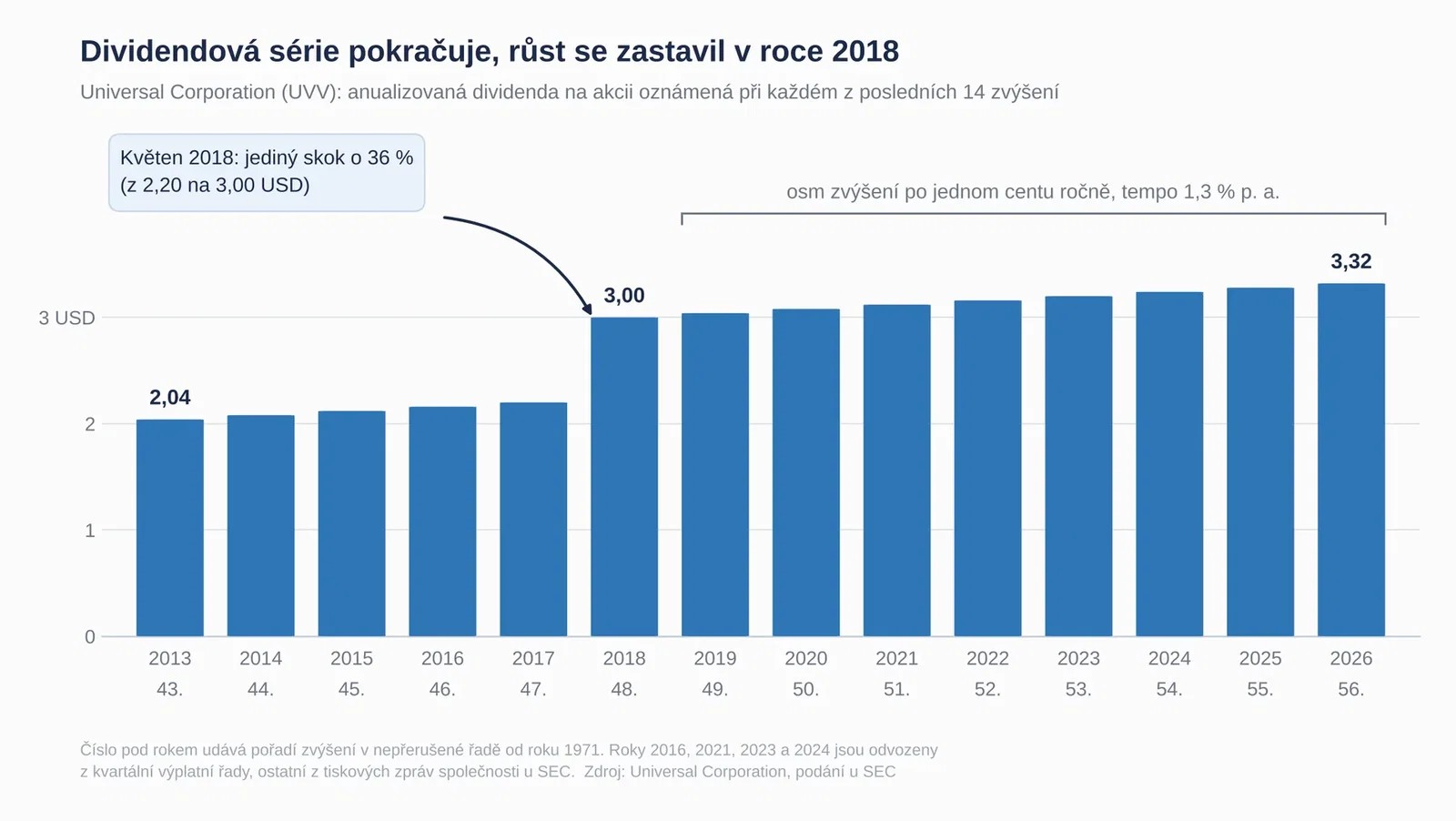
The history proves discipline and the priority management gives to the dividend. CFO Steve Diel called it one of four pillars of capital allocation, alongside tobacco investments, ingredient development and share repurchases. But it doesn't prove that the payout is safe. The long streak creates pressure: management that has never interrupted growth in 56 years has a strong incentive to maintain the dividend even in a year when the business can't justify it. That leads to funding the payout with debt.
Growth is symbolic
The quarterly dividend rose from 0.78 USD in 2021 to 0.83 USD in 2026, just one cent a year, equivalent to a growth rate of around 1.2% and well below inflation. The annual dividend was 2.08 USD after the increase in November 2014 and is 3.32 USD today, a compound growth rate of around 4% over twelve years. Almost all of that growth, however, came in a single step: in May 2018, as part of a new capital allocation strategy, the company raised the dividend by 36% to 3.00 USD a year. Since then, it has grown at a rate of 1.3%. Universal is therefore not an income growth stock; it's a stock with high but virtually static income.
How exceptional is today's yield?
The average annual dividend yield was 3.5% in 2017, 5.2% in 2019, 6.9% in 2020 during the pandemic sell-off, 6.0% in 2023 and 6.2% in 2026, with a four-year average of around 6.0%. Today's 8.58% is about two and a half percentage points above the norm and above the levels seen during the 2020 panic. The key is what drove the yield. Not an increase in the dividend, which rose by 1.2%, but a drop in the share price from 52.74 USD at the start of 2026 to 38.71 USD, or 26.8%. The high yield is the mathematical consequence of a bad year.
To illustrate the power of a high starting yield, the arithmetic is simple: at a yield of 8.58% and with the share price and payout unchanged, dividends alone would return the amount invested in approximately twelve years, and reinvesting them under stable conditions would double the position in just under nine years. This is our own calculation, not a forecast. The weakness is obvious: a 26.8% drop in the share price in a single year wiped out more than three years of dividend income. A high yield protects investors only if the share price doesn't fall faster than the dividend pays out.
Performance over the past five years
A cycle that looked like growth
Revenue rose from 2.10 billion USD in fiscal year 2022 to 2.95 billion USD in fiscal year 2025, then edged down to 2.92 billion USD in fiscal year 2026. Almost all the growth was price-driven. The market went through a classic agricultural cycle: a raw material shortage in 2023 and 2024 pushed green tobacco prices to extraordinary levels, high prices attracted growers, and the result was exceptionally large harvests in fiscal years 2026 and 2027.
According to fiscal year 2026 results, reported operating profit rose from 160.3 million USD in fiscal year 2022 to 232.8 million USD in fiscal year 2025, then fell to 168.5 million USD. Adjusted operating profit, which excludes restructuring and impairment items, was 243.4 and 211.3 million USD in those same two years. Net income attributable to shareholders plunged from 95.0 to 32.6 million USD, a 66% drop, and diluted earnings per share fell from 3.78 to 1.30 USD. The decline was driven by a 52.0 million USD inventory write-down, mainly of dark air-cured tobacco that didn't meet packaging quality standards, and a non-cash write-off of all the goodwill from the 41.1 million USD Shank's acquisition. The first item shows that the company bought raw materials at prices the market didn't support; the second shows that management itself acknowledged overpaying for one of its three acquisitions.